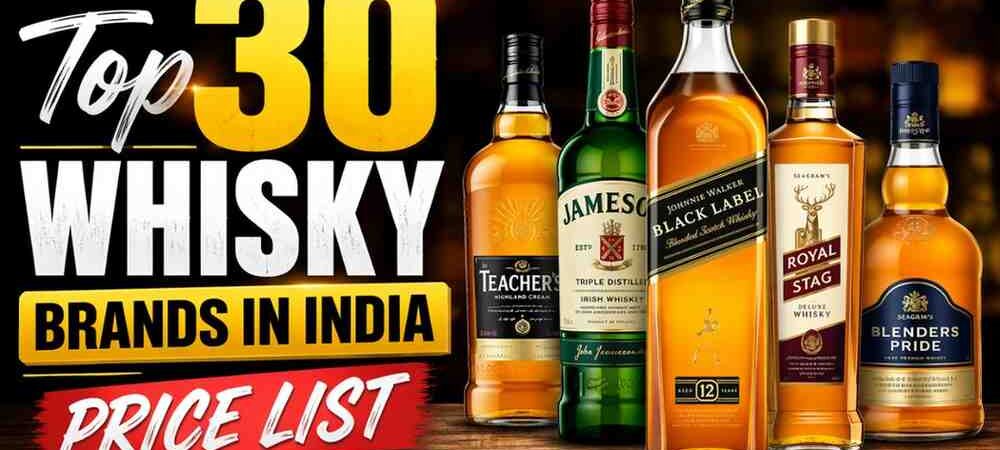
Most whisky price lists stop at the number on the label. This guide goes further — for each of the 30 brands below, you’ll find where it actually came from, who makes it, how easy it is to find on Indian shelves, and what drinkers and critics generally say about it. Prices are also broken down to cost-per-peg (30ml), since that’s the number that matters once the bottle is open.
How Whisky Prices Actually Work in India
Liquor is a state subject in India — excise duty, VAT, and retail margins are all set locally rather than centrally, which is why the same bottle carries a different MRP depending on which state you’re standing in. Price-tracking guides consistently flag Karnataka and Maharashtra as the costliest states to buy whisky in, while Goa and Haryana run cheapest thanks to lower excise. The brand and the liquid never change — only the tax stack does.
Also worth knowing: hard liquor in India is sold almost entirely through state-licensed retail shops and state-run corporations (like TASMAC in Tamil Nadu or the government-run outlets in Delhi and Haryana) — not general e-commerce. A handful of cities allow app-based delivery of beer and wine, but whisky delivery is patchy and state-dependent, so “availability” below mostly comes down to whether your local shop stocks it.
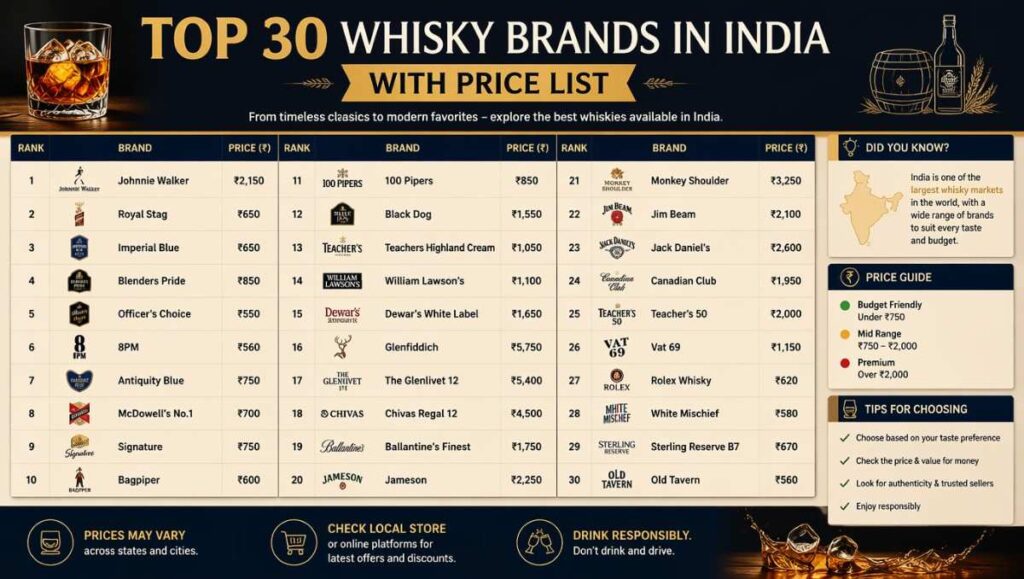
1. Budget Whisky Brands in India (Under ₹800)
These are the highest-volume whiskies in the country, built for everyday drinking and mixing rather than sipping neat.
Officer’s Choice
Origin & history: Launched in 1988 by Kishore Chhabria, who set up Allied Blenders & Distillers (ABD) after leaving his post at Shaw Wallace to revive brands he felt had been overlooked. Officer’s Choice became so dominant that between 2014 and 2019 it was, by volume, the world’s largest-selling whisky — ahead of every international brand. Unlike most Indian whiskies made from molasses, OC is grain-based.
Availability: Sold nationwide in every price tier of liquor shop; it’s the single most common bottle on Indian shelves.
Reviews: Rated highly for pure value and mixability with soda or cola; drinkers generally agree it’s rough when taken neat but does its job at parties and gatherings.
McDowell’s No.1
Origin & history: The McDowell name goes back to a Scottish trading company set up in Madras (now Chennai) in the 1820s, though the whisky brand as it’s known today grew under United Spirits, now owned by Diageo. No.1 has been the flagship whisky in the McDowell’s stable for decades.
Availability: One of the widest-distributed whiskies in the country, present in nearly every state.
Reviews: Known for being mild and inoffensive rather than characterful — a safe, familiar choice that rarely disappoints and rarely excites.
Bagpiper
Origin & history: An old United Spirits brand that built its base in western and southern India, historically one of the brands that competed directly with Officer’s Choice and McDowell’s No.1 for the mass-market crown.
Availability: Strong presence in Maharashtra, Karnataka, and Andhra Pradesh/Telangana in particular.
Reviews: Considered sharper and stronger-tasting than its budget peers — a “gets the job done” whisky more than a smooth sipper.
Director’s Special
Origin & history: Produced by Radico Khaitan, one of India’s oldest spirits companies, whose Rampur distillery roots trace back to 1943. Director’s Special has long been one of Radico’s high-volume, budget-tier whiskies.
Availability: Especially common in North and East India, and a regular pick at weddings and large gatherings for its price-per-crate value.
Reviews: Seen as decent value for group settings; not a whisky most people would choose to drink slowly.
8PM Premium Black
Origin & history: Radico Khaitan’s entry into whisky, launched in the late 1990s as the company expanded beyond its older rum and country-liquor business into branded whisky.
Availability: Widely available, particularly strong in North India where Radico Khaitan has deep distribution.
Reviews: Generally rated a notch smoother than the segment average, without a major price jump.
Royal Stag
Origin & history: Launched by Seagram in 1995, and now owned by Pernod Ricard India after Pernod’s global acquisition of Seagram’s spirits business in the early 2000s. Royal Stag markets itself on using a portion of imported Scotch malt in its blend, which is unusual at this price point.
Availability: One of the two or three best-selling whiskies in the country, sold in every state.
Reviews: Frequently rated the best budget whisky in blind comparisons for its relative smoothness; a common first whisky for many Indian drinkers.
Imperial Blue
Origin & history: Also a Seagram brand, launched in 1997 and now under Pernod Ricard India, positioned as Royal Stag’s direct rival with heavy advertising built around its “Men Will Be Men” campaign.
Availability: Nationwide, similar footprint to Royal Stag.
Reviews: Seen as smoother but slightly simpler in flavour than Royal Stag at almost the same price — often chosen purely on personal habit between the two.
2. Mid-Range Whisky Brands in India (₹800–₹2,000)
The tier most households step up to for parties and gifting — a clear jump in smoothness from the budget segment without moving into full Scotch pricing.
Signature
Origin & history: A United Spirits (now Diageo India) brand built specifically around a “smoothness” positioning, marketed for years as the whisky for people who don’t like the bite of a typical Indian blend.
Availability: Sold across most states, a common gifting and self-purchase choice for first-time premium buyers.
Reviews: Consistently praised for being easy to drink; some tasters find it a little thin in character as a trade-off for that smoothness.
Blenders Pride
Origin & history: Another Seagram-era brand launched in 1995, now under Pernod Ricard India, and one of the longest-running sponsors of India’s fine-dining and cocktail culture through its “Blenders Pride Glassware Collection” and bartending events.
Availability: Extremely widely stocked; one of the default “step-up” whiskies nationwide.
Reviews: Regularly cited as the best all-round value in its price band, balancing smoothness with slightly more character than Signature.
Antiquity Blue
Origin & history: A United Spirits brand launched in the late 1990s, positioned from the start as a more premium-looking bottle within the mid-range segment, with a distinctive tall glass design.
Availability: Present in most metro and tier-2 city liquor shops.
Reviews: Liked for a rounder, slightly sweeter taste than most mid-range rivals; the bottle design is often mentioned as much as the liquid itself.
Black Dog Triple Gold
Origin & history: Black Dog is a genuine blended Scotch, distilled and blended in Scotland and imported/bottled for the Indian market under United Spirits (Diageo India), with roots going back to the late 19th century as a British export brand.
Availability: Common across most states, positioned as an accessible entry into “real” Scotch.
Reviews: Seen as one of the gentler blended Scotches in this price range, popular with drinkers moving up from Indian whisky for the first time.
Black & White
Origin & history: Originally Buchanan’s Blend, created in 1884 by James Buchanan in Scotland and nicknamed “Black & White” for its label design; the brand is now owned globally by Diageo and has been sold in India for generations.
Availability: An older, established name — still findable nationwide though its shelf space has shrunk as newer blends have entered the segment.
Reviews: Viewed as a reliable, old-school Scotch; less talked-about today but still has a loyal older customer base.
VAT 69
Origin & history: Created in 1882 by William Sanderson in Leith, Scotland — the name reportedly comes from the vat number he picked from a lineup during blending trials. Now owned by Diageo, it has been sold in India for decades and built a dedicated following.
Availability: Nationwide, particularly popular in western and southern India.
Reviews: Known for a distinct, slightly nutty character; drinkers tend to either love it specifically or barely notice it, with few in between.
Teacher’s Highland Cream
Origin & history: Founded in 1830 by William Teacher in Glasgow, later owned by Allied Domecq and now part of Beam Suntory globally. It’s built around a heavier proportion of malt whisky in its blend than most rivals in this price band.
Availability: Well distributed across India, a long-standing favourite in Scotch-drinking circles.
Reviews: Frequently named the best-value Scotch under ₹2,000 for its noticeably smokier, maltier profile compared to lighter blends at the same price.
100 Pipers
Origin & history: Created by Chivas Brothers (now under Pernod Ricard) in 1965, largely for export markets — it never became a major seller in the UK but became one of the best-selling Scotch whisky brands in India specifically, a rare case of a brand finding its real home outside its country of origin.
Availability: Extremely widely available across India.
Reviews: Light, easy-drinking, and popular as a soda or water mixer rather than a sipping whisky.
3. Premium Blends & Entry-Level Scotch (₹1,400–₹4,200)
The tier people move to once they’re buying to gift, or keeping a bottle at home specifically for guests.
Ballantine’s Finest
Origin & history: Founded in 1827 by George Ballantine in Edinburgh, now part of Chivas Brothers/Pernod Ricard and one of the best-selling Scotch whiskies in the world by volume.
Availability: Widely stocked in metro cities and increasingly in tier-2 cities.
Reviews: Praised for a soft, honeyed profile that works well over ice; considered a dependable, unremarkable-in-a-good-way Scotch.
Blenders Pride Reserve Collection
Origin & history: A step-up line from standard Blenders Pride, launched by Pernod Ricard India using a longer-aged blend, aimed at drinkers who want more depth without moving to imported Scotch.
Availability: Common across metro and large city liquor stores.
Reviews: Rated as noticeably richer than the standard Blenders Pride, often called the best-value bottle just below the Scotch price bracket.
Johnnie Walker Red Label
Origin & history: The original Johnnie Walker blend, dating back to John Walker’s grocery business in Kilmarnock, Scotland, founded in 1820 and formalised as a whisky blend by his descendants later that century. Now owned by Diageo, it’s the world’s best-selling Scotch whisky by volume.
Availability: Sold in almost every liquor shop in urban India.
Reviews: Considered a spicier, more assertive blend than most rivals at this price — divisive neat, but a strong performer mixed with soda.
Johnnie Walker Black Label
Origin & history: A 12-year-old blend from the same Johnnie Walker house, introduced in the early 20th century as a step above Red Label, and now Diageo’s flagship premium blended Scotch worldwide.
Availability: The default premium gifting whisky in most Indian cities; near-universal availability at any well-stocked shop.
Reviews: Widely regarded as a benchmark blended Scotch — smoky, rounded, and consistent, and the whisky most non-drinkers still recognise by name.
Chivas Regal 12
Origin & history: Chivas Brothers was founded in Aberdeen in 1801 as a grocery, and the Chivas Regal blend itself was introduced in 1909 as a luxury whisky for the American market. It’s now owned by Pernod Ricard and remains India’s go-to premium gifting Scotch.
Availability: Available across nearly all metro and large-city outlets, and a fixture of duty-free shops.
Reviews: Praised for its smoother, fruitier profile compared to Johnnie Walker Black; frequently the top choice for corporate and festival gifting in India.
4. Indian Single Malt Whisky Price List (2026)
The fastest-growing tier in the country, and the one most price lists still skip over entirely. India’s hot, humid climate matures whisky far faster than Scotland’s — a 5-year-old Indian single malt can taste as developed as a 12-year-old Scotch, because the cask loses far more liquid to evaporation each year here (the “angel’s share” runs at 8-12% annually in India versus roughly 2% in Scotland).
Amrut Fusion
Origin & history: Amrut Distilleries was founded in Bangalore in 1948 by J.N. Radhakrishna Rao Jagdale, originally a pharmaceuticals-linked business that moved into brandy and rum for the Indian army before entering whisky. Amrut launched India’s first single malt internationally in 2004, and Fusion — a blend of Indian and peated Scottish barley — followed in 2009, becoming the bottle that convinced the world Indian single malt was a serious category.
Availability: Sold in most metro cities and increasingly in tier-2 cities; cheapest in Karnataka, where it’s distilled.
Reviews: One of the most acclaimed Indian whiskies ever released, once rated third-best whisky in the world by Jim Murray’s Whisky Bible — still considered a benchmark for value against Scotch at the same price.
Paul John Brilliance
Origin & history: Distilled by John Distilleries in Goa, which laid down its first casks in 2008 and launched its single malt internationally in London in 2012. The brand has since won more international awards than any other Indian producer, and its Port Select Cask expression was named World’s Best Indian Single Malt at the 2026 World Whiskies Awards.
Availability: Cheapest in Goa where it’s made; well stocked across major Indian cities.
Reviews: Known for a creamy, tropical, honeyed profile with a peppery finish; commonly recommended as a first single malt for Scotch drinkers switching over.
Indri Trini
Origin & history: Made by Piccadily Distilleries, part of the Piccadily Group that dates back to a Chandigarh restaurant opened in 1967 before entering distilling in 1993. Indri Trini — “The Three Wood” — launched in 2022 and was named Best in Show at the Whiskies of the World Awards 2023, beating Scotch, Japanese, and other world whiskies outright.
Availability: Cheapest in Haryana, where the distillery is based; now sold across most Indian metros and exported to the US, UK, and Australia.
Reviews: Regularly named the most awarded and fastest-growing Indian single malt on the market; praised for its fruity, approachable triple-cask profile that works well as an introduction to the category.
Rampur Select
Origin & history: Produced by Radico Khaitan at a distillery in Rampur, Uttar Pradesh, that has operated since 1943 and came under the Khaitan family in 1972. Rampur Select, the company’s first single malt, launched in 2016.
Availability: Cheapest in Uttar Pradesh; stocked in most major Indian cities and a growing number of export markets.
Reviews: Known as the softest and most delicate of the major Indian single malts, a result of the wider seasonal temperature swings in the Himalayan foothills compared to Goa or Bangalore.
Godawan 100
Origin & history: Diageo India’s artisanal single malt project, distilled at Alwar in Rajasthan and launched in 2022. It’s made from locally-sourced six-row barley and finished in casks treated with Indian botanicals — a technique the brand says no other distillery uses. It’s named after the critically endangered Great Indian Bustard bird (also called the Godawan), and part of its story is tied to funding the bird’s conservation.
Availability: Growing distribution in metro cities and duty-free outlets; still less common outside major markets than Amrut, Paul John, or Indri.
Reviews: Has picked up over 125 international awards since launch and is considered the most distinctive Indian single malt on the market, thanks to its desert-heat maturation and unusual botanical cask finishing.
Kamet
Origin & history: Also made by Piccadily Agro Industries — Indri’s sister brand — and named after Mount Kamet, one of the highest peaks in the Indian Himalayas. It sits alongside Indri and the blended malt Whistler in Piccadily’s whisky portfolio.
Availability: Less widely stocked than Indri, but present in most major cities’ premium liquor stores.
Reviews: Positioned as one of the more affordable entry points into Indian single malt, without the international award profile of its sister brand Indri.
5. Luxury Scotch Whisky Price List (₹3,500 and Above)
For special occasions, gifting to seniors, or the bottle you keep unopened until there’s a reason to open it.
Glenfiddich 12
Origin & history: Founded in 1887 by William Grant in Dufftown, Speyside, and still family-owned today through William Grant & Sons. Glenfiddich is the world’s best-selling single malt Scotch whisky by volume.
Availability: The most common single malt Scotch on Indian shelves, found in nearly every premium liquor store.
Reviews: Widely seen as the standard entry point into single malt Scotch for Indian drinkers — light, pear-and-apple fruity, and easy to enjoy neat.
Glenlivet 12
Origin & history: Founded in 1824 by George Smith, and historically the first distillery to hold a legal licence in Scotland following that year’s Excise Act. Now owned by Chivas Brothers/Pernod Ricard.
Availability: Well distributed in metro cities, often positioned directly next to Glenfiddich on shelves.
Reviews: Regarded as a lighter, fruitier alternative to Glenfiddich, and frequently compared side by side with it as the two classic first single malts.
Macallan 12
Origin & history: Founded in 1824 in Speyside, and today owned by Edrington Group. Macallan built its global reputation on heavy use of ex-sherry casks for maturation, a signature that separates it from most other Speyside malts.
Availability: Limited to premium liquor stores in major cities and duty-free outlets; harder to find in smaller towns.
Reviews: One of the most gifted luxury single malts in India, praised for its rich, dried-fruit sherry character; consistently ranked among the world’s most sought-after whisky brands.
Royal Salute 21
Origin & history: Created by Chivas Brothers in 1953 to mark the coronation of Queen Elizabeth II, aged a minimum of 21 years and traditionally bottled in a hand-finished ceramic flagon.
Availability: Found mainly in high-end liquor stores, duty-free shops, and select five-star hotel bars.
Reviews: Regarded as one of the most recognisable ultra-premium gifting whiskies in India, valued as much for its ceremonial history and packaging as for the whisky itself.
Which Tier Should You Actually Buy From?
If you’re drinking with soda or water at a party, the budget and mid-range tiers do the job — the difference is barely noticeable once mixed. If you’re drinking neat or on the rocks, that’s where the jump to Indian single malts or entry Scotch actually pays off in taste. And if you’re buying to gift, Chivas Regal, Johnnie Walker Black, and Glenfiddich remain the safest, most recognisable choices across generations.
Frequently Asked Questions
Which whisky is the cheapest in India?
Officer’s Choice and Bagpiper are typically the lowest-priced whiskies on Indian shelves, starting around ₹300–350 for a 750ml bottle.
Which state has the cheapest whisky prices in India?
Goa consistently has the lowest liquor prices due to lower state excise duty, followed by Haryana. Karnataka and Maharashtra tend to be the most expensive.
What is the best whisky under ₹1,000 in India?
Royal Stag and Imperial Blue are the most recommended options under ₹1,000, both known for a smoother taste than typical budget whiskies.
Is Indian single malt whisky better than Scotch at the same price?
At similar price points, Indian single malts like Indri, Amrut, and Paul John often show more flavour intensity than basic Scotch, because India’s hot climate matures whisky faster than Scotland’s.
How is “price per peg” calculated?
A standard 750ml bottle contains 25 pegs of 30ml each. Dividing the bottle’s price by 25 gives a realistic cost per drink, which is a fairer way to compare whiskies across price tiers than the bottle price alone.
Prices listed are indicative India-wide ranges for 750ml bottles and vary by state excise duty, retailer, and bottle size. Historical and company details are summarised from public brand and distillery information. Please drink responsibly and only if you are of legal drinking age in your state.