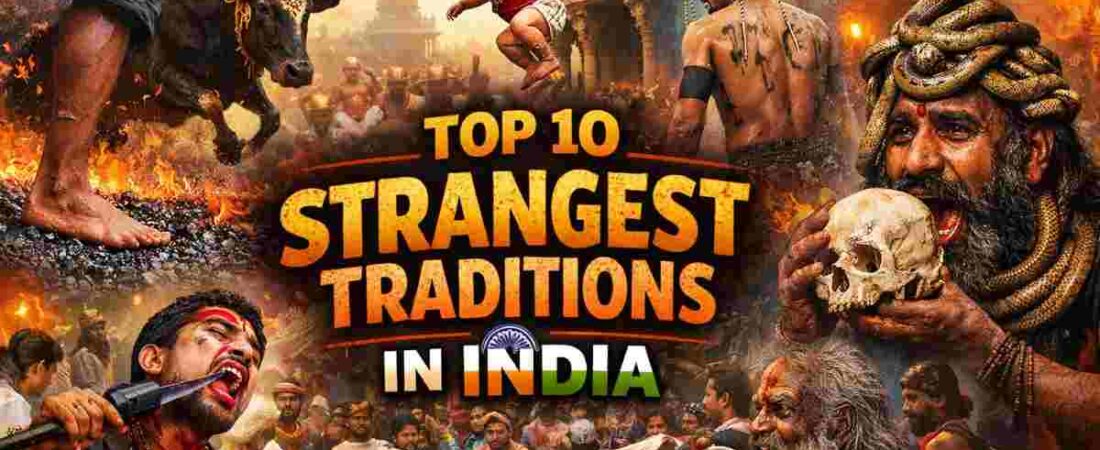
India’s diversity isn’t just about language or food — it shows up in rituals too. Across states, some communities still follow customs that look astonishing to a first-time observer: sliding down ropes on a mountainside, walking barefoot over burning coals, or feeding milk to wild cobras. A few of these traditions have survived court challenges and animal-welfare campaigns; others have quietly changed shape to stay legal. Below are 10 of the strangest traditions in India that are still practiced today, with the real history behind each one and where it stands right now — legally, socially, and in practice.
In this article
- 1. Karni Mata Temple — Rajasthan’s Sacred Rat Worship
- 2. Jallikattu — Tamil Nadu’s Bull-Taming Sport
- 3. Kambala — Karnataka’s Buffalo Race
- 4. Theyyam — Kerala’s Ritual Possession Dance
- 5. Thimithi — Tamil Nadu’s Fire-Walking Ritual
- 6. Thaipusam — The Kavadi Piercing Festival
- 7. Bhunda — Himachal Pradesh’s Rope-Sliding Ritual
- 8. Naga Sadhus — The Ash-Covered Ascetics of the Kumbh Mela
- 9. Nag Panchami — Snake Worship and the Wildlife Law Conflict
- 10. Thulabharam — Kerala’s Weighing Ritual
1. Karni Mata Temple — Rajasthan’s Sacred Rat Worship
Deshnok, RajasthanAt the Karni Mata Temple in Deshnok, near Bikaner, an estimated 25,000 black rats live and roam freely across the temple floor. Devotees consider them sacred, and food nibbled by the rats is treated as blessed prasad and often eaten. Spotting a rare white rat among them is believed to bring especially good fortune.
History: The temple is dedicated to Karni Mata, a 14th–15th century mystic regarded as an incarnation of the goddess Durga. According to legend, when a storyteller’s son in her care died, Karni Mata pleaded with Yama, the god of death, to restore him. Yama refused to return him as a human but agreed to bring him back as a rat — and by extension, she is said to have decreed that all her male descendants (a clan called the Charans) would be reincarnated as rats until they were ready to be reborn into her family again.
Current status: The temple remains fully active today and is a significant pilgrimage and tourist site, managed by a dedicated trust that also runs a sanctuary-style feeding program for the rats using milk, grain, and coconut. It draws visitors from across India and abroad who come specifically to witness the ritual, and the temple has become a well-documented example of animal worship coexisting with modern tourism infrastructure, including designated shoe-free walking areas and daily cleaning routines to manage the rat population hygienically.
2. Jallikattu — Tamil Nadu’s Bull-Taming Sport
Madurai, Theni, Pudukkottai belt, Tamil NaduDuring Pongal, the Tamil harvest festival, a bull is released into a crowd of unarmed men whose only goal is to hold onto its hump for as long as possible without being thrown off. It’s less a “fight” than a raw test of grip strength, timing, and nerve.
History: Jallikattu is documented in Tamil literature going back roughly 2,000 years and was traditionally used as a way for young men to prove their courage — and, in some versions of the custom, to win the right to marry a woman from a bull-owning family whose animal they successfully tamed. The word itself likely combines “jalli” (gold or silver coins tied to the bull’s horns as a prize) and “kattu” (tied). It has long been closely tied to preserving native bull breeds like the Kangayam, since these bulls were bred specifically for temperament and stamina suited to the sport rather than for milk yield.
Current status: Jallikattu has one of the most dramatic legal histories of any Indian tradition. The Supreme Court banned it in 2014 on animal-cruelty grounds, triggering mass protests across Tamil Nadu in 2017 that forced the state government to pass new legislation permitting it under stricter welfare rules. Animal rights groups challenged that law, and in May 2023 a five-judge Constitution Bench of the Supreme Court upheld its validity, ruling that the practice is part of Tamil Nadu’s cultural heritage and that the amended rules sufficiently reduce cruelty. It is legally practiced today under regulations that include mandatory veterinary checks, banned use of alcohol or irritants on the bulls, and registered, trained participants — though review petitions against the 2023 verdict are still pending before the Court.
3. Kambala — Karnataka’s Buffalo Race
Coastal Karnataka (Dakshina Kannada, Udupi)Kambala is a buffalo race held in slushy, waterlogged paddy tracks, where pairs of buffaloes pull a farmer who runs behind them, often reaching striking speeds as crowds cheer from the sidelines.
History: Kambala dates back centuries as a post-harvest ritual among coastal Karnataka’s farming communities, originally performed as a form of thanksgiving to local deities for a good harvest and to keep buffaloes fit for agricultural work. Over generations it evolved from a purely ritual event into a competitive racing sport, with specific breeds of buffalo now raised and trained largely for Kambala racing itself.
Current status: Like Jallikattu, Kambala was banned in 2014 following the Supreme Court’s ruling on animal sports, and organizers pushed the Karnataka state government to pass its own amendment permitting the sport. The May 2023 Supreme Court Constitution Bench ruling covered Kambala alongside Jallikattu and bullock-cart racing, upholding all three as constitutionally valid state-regulated practices. Kambala continues to be held every racing season (broadly October to March) across coastal Karnataka, now organized under a formal committee structure with timing devices, safety rules, and government-recognized race calendars.
4. Theyyam — Kerala’s Ritual Possession Dance
North Malabar, KeralaIn Theyyam, a performer undergoes hours of elaborate face-painting, towering headgear, and costume preparation before entering what is believed to be a state of divine possession — at which point the performer is treated by the community not as an actor, but as the deity itself, offering blessings and settling disputes.
History: Theyyam is believed to predate organized Brahminical worship in the region and is rooted in Dravidian folk religion, ancestor worship, and hero veneration — many Theyyam deities are actually local heroes, warriors, or ancestors who were deified after their deaths, particularly figures who suffered injustice in life. Performers are typically drawn from specific communities, often those from historically marginalized castes, which makes Theyyam one of the few ritual spaces in Kerala where these performers are treated with elevated status and reverence, however briefly, by the wider community.
Current status: Theyyam remains a living, actively performed tradition today, with hundreds of temples and sacred groves across north Kerala hosting performances between roughly November and May each year. Rather than fading, it has gained renewed visibility through cultural tourism and documentary interest, and some troupes now perform ceremonial or shortened versions at cultural festivals outside their original temple context — though practitioners and scholars have raised concerns about diluting its sacred meaning when it’s staged purely for entertainment.
5. Thimithi — Tamil Nadu’s Fire-Walking Ritual
Tamil Nadu, and Tamil communities in Singapore, Mauritius, FijiThimithi involves devotees walking barefoot across a bed of glowing coals, typically at temples dedicated to the goddess Draupadi Amman, as an act of devotion, penance, or thanksgiving for an answered prayer.
History: The ritual is tied to the Mahabharata epic, reenacting the trial of Draupadi, who is believed to have proven her purity by walking through fire unharmed. Devotees who undertake Thimithi typically prepare through weeks of fasting, celibacy, and prayer beforehand, which practitioners believe is what allows them to cross the coals without serious burns — a claim that has also drawn scientific interest into the physics of brief contact with low-conductivity embers.
Current status: Thimithi continues to be performed annually at Draupadi Amman temples across Tamil Nadu, typically around October–November, and has also become a major annual event within Tamil diaspora communities, most famously at the Sri Mariamman Temple in Singapore, where it draws thousands of participants and spectators each year under organized, permitted conditions with medical staff on standby.
6. Thaipusam — The Kavadi Piercing Festival
Tamil Nadu, Tamil communities across South and Southeast AsiaDuring Thaipusam, devotees carry ornate structures called kavadi — ranging from simple pots of milk to elaborate frameworks decorated with peacock feathers — while their skin, tongues, or cheeks are pierced with small hooks and skewers as an act of devotion and penance.
History: The festival honors Lord Murugan and specifically commemorates the moment his mother, Parvati, gave him a vel (a divine spear) to defeat the demon Soorapadman. Devotees undertake vows involving weeks of fasting and abstinence before the festival, and the piercings are performed as a personal offering, often as thanks after a prayer has been answered.
Current status: Thaipusam remains widely observed at Murugan temples across Tamil Nadu, and has grown into one of the largest festivals in the Tamil diaspora, with the Batu Caves procession in Malaysia drawing over a million participants and spectators annually. Devotees are said to enter a trance state through prayer and drumming that allows them to carry the pierced kavadi without visible pain or bleeding, a phenomenon that continues to draw both religious devotion and scientific curiosity.
7. Bhunda — Himachal Pradesh’s Rope-Sliding Ritual
Shimla and Kullu districts, Himachal PradeshBhunda is a rare, elaborate festival centered on a man from the Beda community sliding down a long rope stretched from a hilltop to a lower point, using a wooden saddle, as an offering to the deity Parashuram.
History: The ritual is widely understood to be a symbolic substitute for an older practice of human sacrifice once associated with the region’s deity worship — the rope-slide is believed to represent the sacrificial victim’s escape or transformation rather than an execution. It is held only once every few decades in a given village (some accounts cite intervals of 25 years or more) because of the scale of preparation involved: a massive rope has to be handmade from local grass or bark fiber, strong enough to bear a man’s weight across a steep gradient.
Current status: Bhunda is still performed today, though rarely, given how infrequently any single village holds it — it survives as a living ritual precisely because it’s treated as a once-in-a-generation event rather than an annual fixture. Local administrations typically get involved in permitting and safety oversight given the physical risk involved in the rope-slide, and the festival continues to draw significant regional attention whenever a village revives it.
8. Naga Sadhus — The Ash-Covered Ascetics of the Kumbh Mela
Pan-India, most visible at the Kumbh MelaNaga Sadhus are Hindu ascetics who renounce clothing entirely, cover their bodies in sacred ash, and dedicate themselves to extreme austerity, appearing most publicly during the Kumbh Mela, where their ceremonial procession into the river for the first holy dip is one of the event’s most striking sights.
History: The Naga Sadhu tradition is linked to militant ascetic orders (akharas) that historically also served as armed defenders of Hindu temples and pilgrimage routes, particularly during periods of external invasion. Becoming a Naga Sadhu traditionally involves a long, demanding initiation process — years of discipleship, renunciation of worldly ties including family and possessions, and rituals symbolizing death and rebirth into ascetic life — and nudity is treated as the ultimate rejection of material attachment, including attachment to modesty itself.
Current status: Naga Sadhus remain an active, organized ascetic community today, structured under traditional akharas that still hold real influence over Kumbh Mela proceedings and processional order. They appear in the largest numbers at the Kumbh Mela, held on a rotating basis at Prayagraj, Haridwar, Ujjain, and Nashik, with the most recent Maha Kumbh at Prayagraj in early 2025 drawing tens of millions of pilgrims and extensive global media coverage of the Naga Sadhu processions specifically.
9. Nag Panchami — Snake Worship and the Wildlife Law Conflict
Maharashtra (notably Battis Shirala), Rajasthan, and other statesOn Nag Panchami, devotees traditionally worship snakes, particularly cobras, offering them milk, vermillion, and prayers in the belief that this brings protection from snakebite and removes astrological doshas linked to serpents.
History: The festival has roots in the Mahabharata, where the sage Astika is said to have stopped King Janamejaya from wiping out the entire serpent race in a sacrificial fire, in retribution for his father’s death by snakebite. Snake, or Naga, worship reflects an older reverence for serpents as powerful, semi-divine beings in Indian tradition, and the village of Battis Shirala in Maharashtra became particularly famous for large public processions featuring live cobras captured specifically for the festival.
Current status: This is one of the clearest examples of a tradition actively reshaped by law. Cobras are protected under Schedule I of the Wildlife Protection Act, 1972, making their capture, display, or trade illegal, and the Bombay High Court banned Battis Shirala’s live-cobra processions back in 2002. Snake charmers have also historically caused serious harm to the animals — removing fangs, stitching mouths shut, and force-feeding milk that snakes cannot actually digest, which frequently proved fatal. In mid-2025, Maharashtra’s forest ministry faced significant backlash from wildlife experts and activists after signaling interest in reviving the practice, and a controversial short-window permit allowing capture of a limited number of cobras for “educational purposes” around the festival drew further criticism. In most of the country today, Nag Panchami is now observed through idol worship, images, and offerings at temples rather than live snakes, with forest departments and NGOs conducting active surveillance to intercept illegal snake charmers during the festival period.
10. Thulabharam — Kerala’s Weighing Ritual
Guruvayur and other temples, KeralaIn Thulabharam, a devotee sits on one side of a large traditional weighing scale while the other side is loaded with an equivalent weight of an offering — commonly bananas, sugar, coconuts, or in some cases gold and silver — which is then donated to the temple.
History: Thulabharam is rooted in the concept of tulapurushadana, an ancient practice described in Hindu texts where a person’s weight in valuable goods was offered as an act of charity and gratitude, historically associated with kings and wealthy patrons making large donations to temples or Brahmins. Over time it became accessible to ordinary devotees as a way to fulfill a vow, thank a deity for a specific blessing (recovery from illness, a wish fulfilled, a child’s wellbeing), or mark a significant life event.
Current status: Thulabharam remains an active, popular ritual today, especially at Guruvayur Sri Krishna Temple in Kerala, where devotees regularly perform it as part of routine temple offerings rather than as a rare occasion. Temples have modernized the logistics considerably, with dedicated weighing halls, price lists for different offering materials, and receipts issued for the donated goods, making it one of the more accessible and commercially organized rituals on this list.
Why Do These Traditions Persist?
Very few of these customs survive purely out of habit. Jallikattu and Kambala persisted through direct legal battles because entire farming communities built their identity and livelihoods around them. Nag Panchami is actively being renegotiated between religious sentiment and wildlife law in real time. Theyyam and Thaipusam continue to draw new generations of devotees precisely because the intensity of the ritual — pain, possession, fire — is what makes the devotion feel real to participants. Strange as these traditions look from the outside, each one is doing serious cultural work: preserving caste-community identity, marking the agricultural calendar, or giving people a physical way to express faith that words can’t capture.
Frequently Asked Questions
Is Jallikattu legal in India right now?
Yes. After a 2014 Supreme Court ban and years of protest, Tamil Nadu passed amendments permitting Jallikattu under strict welfare rules, and a five-judge Constitution Bench of the Supreme Court upheld those amendments as constitutionally valid in May 2023, allowing the sport to continue.
Is live snake worship still allowed during Nag Panchami?
Largely no. Cobras are protected under Schedule I of the Wildlife Protection Act, 1972, and capturing or displaying them is illegal. Live-cobra processions in places like Battis Shirala have been banned by courts since 2002, and most Nag Panchami worship today uses idols or images instead of live snakes.
Can tourists visit these rituals in person?
Several are openly accessible, including the Karni Mata Temple, Jallikattu and Kambala events, Thaipusam processions, and Thulabharam at Guruvayur. Others, like Bhunda, are held so rarely that witnessing one depends entirely on timing and local access, and some Theyyam performances are restricted to community members during their sacred temple context.
Why have courts gotten involved in some of these traditions?
Traditions involving animals — Jallikattu, Kambala, and Nag Panchami in particular — have drawn legal scrutiny under the Prevention of Cruelty to Animals Act and the Wildlife Protection Act, leading to a repeated cycle of bans, state-level amendments, and Supreme Court rulings balancing animal welfare against cultural heritage claims.