10 Facts You Won’t Believe Are True (Until You See #1)
No myths. No clickbait exaggeration. Just 10 real, documented facts — ranked from “huh, okay” to “wait, WHAT?” Read to the end before you Google any of them to check.
Here’s a small experiment. Before you scroll any further, pick a number between 1 and 10 in your head. Now promise yourself you won’t skip ahead to it.
Every fact on this list sounds like something a friend made up after one too many YouTube rabbit holes. They’re not made up. Each one is a real, verifiable fact — the kind that historians, biologists, and astronomers will confirm without blinking. We’ve ranked them from mildly surprising to genuinely hard to accept, and we’re betting the one at the very top will make you stop and re-read it twice.
Let’s start climbing.
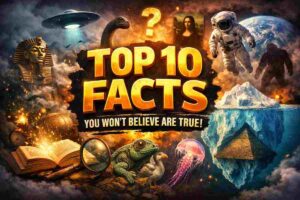
Quick Jump — All 10 Facts
- Oxford University predates the Aztec Empire
- Sharks are older than trees
- Venus spins backward — and its sun rises in the west
- Wood frogs freeze solid every winter and come back to life
- The “immortal” jellyfish can reverse its own age
- Peanuts aren’t nuts at all
- Bananas are berries. Strawberries technically aren’t
- Every gram of gold ever mined would fit in three swimming pools
- France used the guillotine the same year Star Wars hit theatres
- 3,000-year-old honey has been found perfectly edible
Oxford University Is Older Than the Aztec Empire
Teaching at Oxford is documented as far back as 1096 — centuries before the Aztec civilization even existed. The city of Tenochtitlan, the heart of the Aztec Empire, wasn’t founded until 1325.
That means students were already attending lectures at Oxford for over two hundred years before the Aztec Empire began. Two civilizations we tend to picture in completely different eras were, for a while, running in parallel — just not the parallel most people assume.
Sharks Are Older Than Trees
Sharks have been swimming in Earth’s oceans for roughly 400 million years. The first trees didn’t appear on land until around 350 million years ago.
For nearly 50 million years, sharks patrolled a planet that had oceans, sunlight, and predators — but zero forests. Somewhere out there, a shark was older than the very concept of a “tree.” Sharks have also survived four of the five mass extinction events in Earth’s history.
Venus Spins Backward — Its Sun Rises in the West
Every planet in our solar system rotates counter-clockwise when viewed from above — except Venus. It rotates clockwise, in the exact opposite direction of Earth and almost every other planet.
Scientists believe a massive ancient collision may have literally flipped Venus’s spin. The practical result: if you stood on Venus’s surface (and survived its 465°C heat), you’d watch the sun rise in the west and set in the east — the reverse of every sunrise you’ve ever seen.
Wood Frogs Freeze Solid Every Winter — Then Come Back to Life
When temperatures drop below freezing, the wood frog doesn’t burrow away or migrate. It freezes. Its heart stops beating, its breathing stops entirely, and up to 70% of the water in its body turns to literal ice.
Come spring, the frog simply thaws, its heart restarts on its own, and it hops away as if nothing happened — no CPR, no doctor, no drama.
The “Immortal” Jellyfish Can Reverse Its Own Aging
Meet Turritopsis dohrnii, a tiny jellyfish with a biological trick that sounds impossible: when it’s injured, stressed, or simply aging, it can revert its own cells back to a juvenile stage and effectively start its life cycle over again.
Scientists call this process transdifferentiation — it’s the closest thing nature has to hitting “undo” on aging itself. In theory, this jellyfish could repeat the cycle indefinitely, making it biologically immortal (predators and disease are a different story).
Peanuts Aren’t Actually Nuts
Despite the name, the peanut has more in common with beans, lentils, and peas than it does with almonds or walnuts. Botanically, it belongs to the legume family — it grows underground in a pod, which is why it’s also called a groundnut.
This isn’t just trivia — it’s the actual reason some people can safely eat tree nuts like almonds or cashews while still being allergic to peanuts. Two completely different biological families, one confusing shared name.
Bananas Are Berries — Strawberries Technically Aren’t
Botanically speaking, a “true berry” must develop from a single flower ovary with its seeds embedded inside the flesh. Bananas check every one of those boxes.
Strawberries do not. Their seeds sit on the outside of the fruit, which technically makes them an “aggregate accessory fruit” — not a true berry at all. So the fruit everyone calls a berry, isn’t one, and the one nobody thinks of as a berry, actually is.
Every Ounce of Gold Ever Mined Would Fit in Three Swimming Pools
Gold has been mined by human civilization for thousands of years, across every continent, by empires, prospectors, and modern mining corporations alike. Given that history, you’d expect a mountain of it somewhere.
Instead, geologists estimate that all the gold humans have ever pulled out of the earth — every coin, every ring, every bar in every vault — would fit into roughly three Olympic-sized swimming pools. One of the rarest, most fought-over resources in human history barely takes up any space at all.
France Was Still Using the Guillotine the Same Year Star Wars Released
Picture 1977. Audiences were lining up in cinemas to watch lightsabers and spaceships in Star Wars for the very first time. That same year, France carried out its last execution by guillotine — a device most people associate with the French Revolution, nearly two centuries earlier.
The timeline collapse here is genuinely dizzying: a piece of 18th-century execution technology and a groundbreaking sci-fi blockbuster existed in the same calendar year. France didn’t formally abolish the death penalty until 1981.
3,000-Year-Old Honey Has Been Found Perfectly Edible
Archaeologists excavating ancient Egyptian tombs have recovered sealed pots of honey that are roughly 3,000 years old — and found them chemically stable, unspoiled, and technically still safe to eat.
Honey’s low moisture content and natural acidity make it one of the only foods on Earth with essentially no expiration date, as long as it stays sealed and dry. Everything else in your kitchen has a shelf life measured in months. Honey’s shelf life is measured in millennia.
That jar in your kitchen cabinet? Under the right conditions, it could theoretically outlive your great-great-great-grandchildren.
So, Which One Got You?
Ten facts, all real, all verifiable — and somehow the honey one still feels like the hardest to accept. That’s the strange part about truth: it doesn’t need to be believable to be real. Save this list for your next trivia night, and watch someone insist you’re making at least one of these up.
Frequently Asked Questions
Are these facts actually verified, or just internet trivia?
Every fact listed here is drawn from well-documented history, biology, and astronomy — the kind of information confirmed by historians, scientists, and academic institutions rather than unverified social media claims.
Which fact on this list is the most scientifically interesting?
The immortal jellyfish and the freezing wood frog are the two most scientifically remarkable, since both involve biological processes — transdifferentiation and natural antifreeze production — that researchers are still actively studying.
Why does honey never spoil?
Honey has very low moisture content and naturally high acidity, which makes it extremely difficult for bacteria or microorganisms to survive in it. As long as it remains sealed and free of moisture, it can technically last indefinitely.
Is it true that bananas are berries but strawberries aren’t?
Yes. Botanical classification depends on how a fruit develops from a flower’s ovary, not on common naming. Bananas meet the technical definition of a true berry, while strawberries are classified differently because their seeds sit on the outside.